As I already mentioned, I started playing the organ at a time when I was very busy. Spending much time by studying a musical notation I considered (and consider still) a waste of time, that better could be used by playing the music. In fact I started studying the traditional notation, but very soon I had the feeling, that the result would be a repertoire of about three pieces of music, learned by heart for the most part of it. I did not like that perspective very much. The solution I found was Klavar. You may not expect to become a top artist without any practice. Even with Klavar that's impossible. The fact that reading Klavar is easy, can't eliminate the need for practicing your fingers to do what the notation indicates they must do. That will cost some time. But I'm sure, I never would have learned playing the organ if Klavar did not exist.
It is said before: KLAVAR is FUN!
Using Klavar, playing an instrument becomes an occupation giving you "a joy for ever". Very quickly after the start there will be a lot of music available, that you can play. Sometimes that's a kind of disadvantage, because you may feel the temptation to switch quickly from one piece of music to another, without learning the previous one well. In such cases some discipline will be needed.
Klavar is a complete musical notation, all the intentions of composers can be registered with it and it can be used for all sorts of musical instruments and for singing. But the great advantages of Klavar will undoubtedly be discovered while using instruments with a 'piano-keyboard'. Many of the Klavar publications are meant for that kind of instruments. But it is very well possible, that users of either kind of musical notation play together, because, where the notation may be different, the music is not!
Please understand, I'm not a teacher and this is not a lesson. I only want to show you the principles of Klavar. For a good explanation try one of the trial lessons of Klavarskribo.
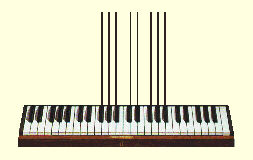
 As you can see in
the adjacent picture a Klavar-stave is made up of groups of 2 and
3 lines in turn. The lines of the group of three are drawn
somewhat thicker than those of the group of two lines. The
key-board at the bottom makes it clear, why this arrangement of
lines has been chosen. The black keys of it show the same
pattern. And the black keys are the player's guides to the
correct key.
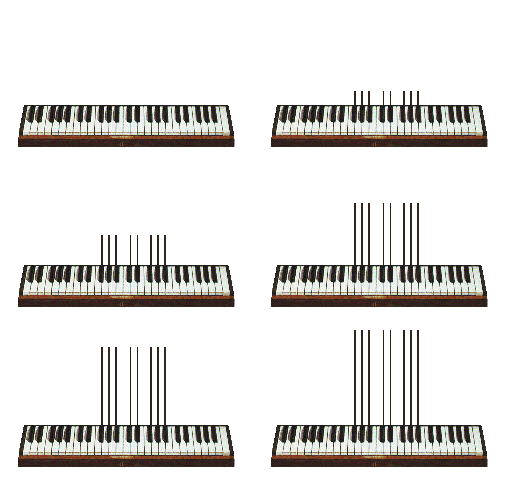
As you can see in
the adjacent picture a Klavar-stave is made up of groups of 2 and
3 lines in turn. The lines of the group of three are drawn
somewhat thicker than those of the group of two lines. The
key-board at the bottom makes it clear, why this arrangement of
lines has been chosen. The black keys of it show the same
pattern. And the black keys are the player's guides to the
correct key.
 Notes that sound
simultaneously, e.g. for the left and right hand or as a chord,
are put at equal level in the Klavar stave. Notes or chords
played in a sequence are put underneath each other. So you read
Klavar notes from the top of the stave to the bottom. If a black
key must be struck, the note on the stave will be black and drawn
on the line representing the black key. A white (open) note
indicates, that a white key must be struck and lies between the
black lines, as the white keys do between the black ones. Black
notes are drawn above the stem (the small horizontal line on the
note), white notes under the stem. The stem indicates with which
hand the note or chord must be played. If the stem points to the
right, the right hand must play the notes. When the stem points
to the left, the left hand must play them.
Notes that sound
simultaneously, e.g. for the left and right hand or as a chord,
are put at equal level in the Klavar stave. Notes or chords
played in a sequence are put underneath each other. So you read
Klavar notes from the top of the stave to the bottom. If a black
key must be struck, the note on the stave will be black and drawn
on the line representing the black key. A white (open) note
indicates, that a white key must be struck and lies between the
black lines, as the white keys do between the black ones. Black
notes are drawn above the stem (the small horizontal line on the
note), white notes under the stem. The stem indicates with which
hand the note or chord must be played. If the stem points to the
right, the right hand must play the notes. When the stem points
to the left, the left hand must play them.
If for some reason notes must be played that do not fit on the present stave, some help lines will be temporarily added in the above mentioned arrangement of two and/or three lines.
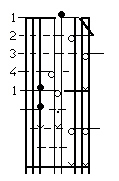
In the picture, only meant as an example, not as a piece of music or a tune, is indicated, that first the right black key of a group of two must be played. The right hand must do that, because the stem points to the right. Then a white key must be played. This key is situated directly to the left of the left black key, that belongs to a group of three. Then again a white note appears on the stave, so a white key must be struck. This one is situated between two black keys, the middle and the right one of the same group of three, mentioned before
Then the left hand must start playing because the stem of the next note points to the left. The note is open, so a white key must be played. This key you can find directly to the left of the group of two black keys. Then you see a group of two notes on one stem. Such notes must be played simultaneously and form a "chord". For the black note you must strike the right black key of the group of three, the white key lies between the two black keys forming a group.
 Until
now I did not mention the duration of the notes and the way
Klavar indicates that. But I hope I made it clear, that the
colour of the notes (black or white) has nothing to do with it.
The colour is only determined by the position of the note on the
stave. A note to be played on a black key is black and drawn
through the corresponding black line. When a white key must be
struck the note is white and drawn between the lines. The slanted
line, that connects the two first notes of the example, has
nothing to do with the duration of notes either. So it must not
be mixed up with beamed notes of the traditional notation. Klavar
uses such lines only to clarify the structure of a piece of
music. These lines are called 'grouping lines'.
Until
now I did not mention the duration of the notes and the way
Klavar indicates that. But I hope I made it clear, that the
colour of the notes (black or white) has nothing to do with it.
The colour is only determined by the position of the note on the
stave. A note to be played on a black key is black and drawn
through the corresponding black line. When a white key must be
struck the note is white and drawn between the lines. The slanted
line, that connects the two first notes of the example, has
nothing to do with the duration of notes either. So it must not
be mixed up with beamed notes of the traditional notation. Klavar
uses such lines only to clarify the structure of a piece of
music. These lines are called 'grouping lines'.
Because you already can find the keys, when you see the notes on the stave, the keyboard at the bottom is left out. In addition to the well known notes, you will see some new things, in and next to the stave. First of all there are horizontal lines. If a line is drawn across the stave and the only place left open is used by the notes, then the line is called a 'bar line'. In the example there are three bar lines. A bar line separates bars, which are the basic parts of the time division in a piece of music. The bar line is drawn somewhat thicker than the other horizontal lines (but not always as much as in the example). The horizontal dash lines in the example are 'count lines'.
At the start of every piece of music you will find some figures next to the Klavar-stave, as in the example. These figures are found at the same level as the bar and the count lines. In this way is indicated in how many counts a bar is divided. In the example a bar contains four counts. Other divisions of a bar are possible, of course. If the division of the bars is changed during the piece, then Klavar will indicate this new division by placing according figures next to the stave.
You will already have discovered, that the stems of the notes coincide with the bar or the count lines. In Klavar the stems (and not the head of the notes) indicate the exact time on which a note must be played. From the example you can see, that exact on the first count of bar 1 a black note must be played, on count 2 a white note and on count 3 another white note. All these notes are played with the right hand, because the stems point to the right. The last note of the first bar is a white note, that must be played with the left hand.
I told you when to
strike a key, but I did not tell you, when to release it. In
principle a key is released at the same time that a new key is
played by the same hand. The first (black) key is released at the
moment that the second (white) note must be played. So the
duration of the first note is one count. The next white note
sounds for one count too, because a new white note must be played
on count 3.
Let's look, for a moment, only at the right hand notes. Then you will see, that it lasts 4 counts before the next notes appear. But above the bar line of the second bar, so two counts after the last right hand note was played, you can see a little sign, looking like a 'v'. That sign is called a 'stop sign' or a 'rest' in Klavar terminology. This sign indicates, that the note above this sign has to stop at that moment. So the key must be released, without striking another key with the same hand. This is an exception to the rule I stated before. And another is coming.
Now let's look at the left hand. This hand has nothing to do during the first three counts of the first bar. But on count 4 of it a note must be played. One count later, so on count 1 of bar 2, this note is released, because a chord must be played. On count 2 of bar 2 you will see another sign, that has not been discussed. In this case it's a dot underneath the white note of the previous chord. At the same level, so at the same time, you will see a black note, that must be played again. According to the rule the white key should be released, but the meaning of the dot is to indicate, that the note above it must continue sounding, so the key must not be released. The dot is called a 'continuation dot'. And here we have our second exception to the rule. With the knowledge now available we can complete the rule as follows: a note is released as a new note must be played by the same hand or when a rest for that note is found, except for the case a continuation dot prevents that. On the next count line you will see two rests, indicating that the notes of the chord must stop. From there on the left hand has nothing to do anymore.
Let's complete the example. At the moment, that the left hand releases the notes of the chord, so on count 3 of bar 2, the right hand plays a chord of two white notes and that during 2 counts, as you can see from the two rests at the bar line of bar 3 (that has been drawn for only a very small part).
The example doesn't show the possibility to start
or stop notes between two count lines. Notes with a duration,
that not equals a count, are very often used in real music. In
Klavar these notes or rests are placed between the count lines
exactly on the position on which they must start or stop,
considering the stave to be a linear time ruler.
 If you look
accurately, you will discover, that I did not tell you, where
exactly on the keyboard you must play. You can find groups of two
and three black keys all over it. So the relative position of the
notes was given, but not the exact pitch. To pin-point the stave
to the keyboard, Klavar uses a set of two dash lines. These two
lines coincide with two black keys directly to the right of what
is called the 'central C' (also c' or the C with a frequency of
about 261.6 Hz). This C is mostly found in the middle of the
instrument. The manual of it can tell you more about that.
If you look
accurately, you will discover, that I did not tell you, where
exactly on the keyboard you must play. You can find groups of two
and three black keys all over it. So the relative position of the
notes was given, but not the exact pitch. To pin-point the stave
to the keyboard, Klavar uses a set of two dash lines. These two
lines coincide with two black keys directly to the right of what
is called the 'central C' (also c' or the C with a frequency of
about 261.6 Hz). This C is mostly found in the middle of the
instrument. The manual of it can tell you more about that.

What more?
To be honest, there is not much more! Almost all what there is to know about the Klavar notation I have told you. And that's the truth. In the next paragraph you will find some reasons, why I prefer Klavar. If you are interested in Klavar you could ask for a free trial lesson by contacting the earlier mentioned Klavar foundation (PO box 39, 2980 AA Ridderkerk, the Netherlands). Then you can hear it from experts! You also can contact the site of the Klavar Music Foundation of Great Britain.
If you are (a bit) acquainted with the traditional notation, then the following remarks may make it clear, why I prefer the Klavar notation.
There are some more things that makes the reading of Klavar easier than the traditional notation. For me it is important, that Klavar is a more direct and logical way to represent a piece of music in all its details.
If you have a program that can handle .pcx files, then you could now down load a German folk song for 4 voices, that gives a quite good impression of the real Klavar look. Even when it's played on a piano or an (electronic) organ it sounds good. But you must be aware of the fact that the file uses 170 kB. It's a .zip file that must be decompressed by an 'unzip' program. The resulting file (with the name ksl.pcx) can be printed by paint programs like Corel PHOTO-PAINT, Paint Shop Pro or Micrografx Photo Magic. Probably you may use other paint programs as well, but these three are tested by me.
The piece of music is not very difficult, but not exactly something for the very first time you want to play. See what you can do with it!
Start Klavar explanation again.
Back to the Home page